
When I first arrived in Cuenca, I couldn't work out why strangers kept talking to me while I ate. I'd be halfway through an almuerzo (the set lunch enjoyed by locals) in El Centro, and someone walking in the door would catch my eye, say "buen provecho," and go sit at their own table. I assumed I'd met them somewhere. I hadn't.
So I asked Michelle. She grew up in Quito, she's spent her whole life around this, and she looked at me the way you'd look at someone asking why people say good morning. "You just say it back," she said. "It means enjoy your meal. Everyone says it." Not to friends. To the room. To you, a confused gringo with soup on his chin.
That small thing, a stranger wishing you well over your lunch, turns out to be the thread that runs through everything I love about eating in this city. And it's a big part of why people who actually know food keep saying Cuenca punches above its weight.
I came to Ecuador in 2016, settled in Cuenca soon after, and we've run YapaTree here since 2021 (it was GringoTree before we took it over). For the Cuenca Eats map we teamed up with James Li for the first time. James wrote Cuenca Eats, he's a Google Maps Level 8 Local Guide, and he's exactly the person you'd want telling you where to eat in this city. So when he sent through his thoughts on what makes the food scene here special, I paid attention.
What locals do at lunch
In 2024 the World Food Travel Association named Cuenca the first World Food Capital in South America, and in 2025 UNESCO added it to its Creative Cities of Gastronomy. Those are nice, but they're not how I'd convince you. Watch what happens at lunchtime. Here's how James puts it:
I love seeing laborers lay down anywhere they find a patch of grass after lunch for a quick deep nap. The thousands of restaurants here that exist just to feed the city at lunchtime is hard to fathom. By watching what happens here at lunchtime, I've learned that the city's eating culture both reflects and enlarges a lifestyle where even strangers are greeted as vecinos, police share tables with families, kids play under the table while parents drink their soup, and where people walking into a restaurant greet diners with 'buen provecho.'
Walk past a good almuerzo place at one o'clock and the kitchen is flat out like a lizard drinking, plates flying, not a free seat in the house. None of that turns up in a star rating, and it's the whole point.
That's why this city's food culture doesn't read the same from the outside. You won't find it by hunting for the one chef doing a tasting menu in El Vergel. You find it on a normal Tuesday, in a hueca where laborers, students, and abuelas are all working through the same $3 plate.
What's at risk
Here's the part James worries about, and I'll be honest, it worries me too. He told me this story about a Cuenca-trained chef:
I recently spoke with an expert chef, trained in all of the traditional Ecuadorian dishes, who told me she had to change her menu to mostly American and British food because none of her customers appreciated her Ecuadorian menu. Given the culinary tradition here, I believe that's a problem with discovery and marketing, not with the food that's here.
He kept going:
People don't make the trip to Cambodia, Italy or Ethiopia to eat burgers and chips. Those who feel that's all that they can eat here are missing out on the real food scene.
That's the quiet tension in Cuenca right now. The international scene is expanding fast, and there's nothing wrong with a good burger. But every year there are more places doing pizzas, pastas, ribs, and wings, and the huecas (the holes-in-the-wall) and mercado kitchens, the exact food that built this city's reputation, get a little harder to find unless you know where to look.
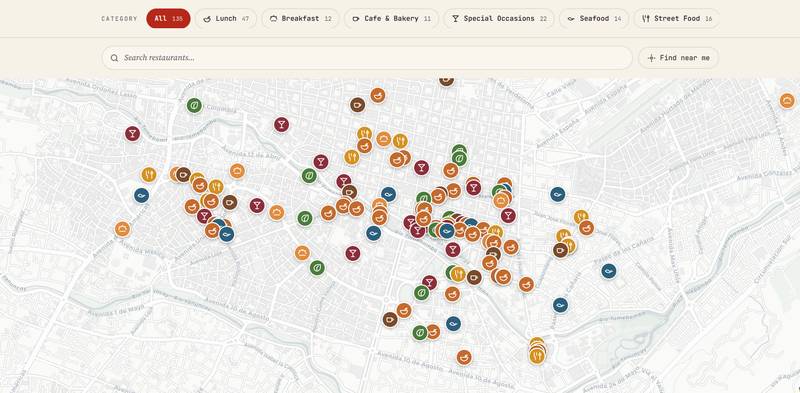
That's what our Cuenca Eats map is for. James curated 116 places in his book, and we've added another 19 from his second-edition notes. Search by neighborhood, filter by what you're after (almuerzo, seafood, cafe, street food), and tap any pin for the hours, the address, and a one-line hook from James. Every pin is a restaurant where, in his words, "the clientele is diverse: kids, old women, hard-hatted laborers, uniformed workers, businessmen, maybe a dog or pigeon wandering around. Coke and Pepsi come in glass bottles."
You can actually live this
Here's what matters if you're reading this from somewhere else, weighing up a move. This food culture isn't something you visit for a weekend. You live it, three meals a day. At the almuerzo level, the set lunch most locals eat, you're looking at $3 to $5 a plate. Sit-down dinners and the specialty places cost more, of course. But the everyday baseline, the way most of the city actually eats, sits down there.
For anyone running the numbers on a move, that changes the maths. You're not paying a premium for the privilege of eating fresh fish in the Andes. James again:
Ecuador has strong ties to the ocean and because it's geographically a small country, seafood dishes originating from the coast, the Caribbean and the Amazon have become familiar throughout the entire country. I think that's led to demand for high-quality fresh fish even in a place like Cuenca, where its larger markets, like El Arenal, receive fresh fish from the coast almost every dawn. That's amazing.
It is. So is the fact that Ecuador is the origin point for tomatoes, peppers, beans, potatoes (over 400 native varieties), corn, peanuts, cassava, and chocolate. Most of those still grow within a couple of hours of Cuenca, sold by the people who farmed them, in markets where the prices haven't been bent out of shape by export demand.
A lot of people who move here end up organizing part of their week around the nearest mercado. Not because they've turned into foodies, but because the fruit and veg a few blocks from home is fresher, cheaper, and better than anything they had access to before. That's not eccentric. That's just understanding what you moved here for.
One last thing, your Yapa
Years ago James tried cuy (roasted guinea pig) in Quito, hated it, and swore it off. For years. Then, after a couple of friends kept insisting, he and his wife went to a cuy restaurant here in Cuenca, Tres Estrellas, mostly just to watch the scene:
Every table was filled with Ecuadorian families enjoying platters of roasted cuys. My wife ordered a vegetarian meal and I ordered some pork. The waiter kept coming back to our table and shaking his head. 'You know, this is a cuy restaurant, right? You sure you don't want to try one?' He acted as if we were the only customers ever to have dined there sans cuy.
A few months later, James went back, took a tentative bite of a leg, and never looked back. "It was really delicious."
I think about that story a lot, because I did the same thing in reverse a dozen times when I first got here. The dish I was sure wasn't for me, the soup dish (encebollado) I couldn't pronounce, the thing on the next table I was too shy to point at, half of those ended up on my regular rotation. Cuenca has a way of feeding you better than you'd feed yourself, if you let it. So next time you're caught between the safe order and the one you can't pronounce, point at the one you can't pronounce.
The map will get you started. The book is where it all makes sense. James spent three years walking Cuenca's mercados and talking to the people who feed the city, and Cuenca Eats is the result: a bilingual guide to more than 100 local dishes, drinks, fruits and snacks, plus over 100 restaurants found the honest way. Read it and you'll order in Cuenca like you've lived here for years.
Read the full book → A bilingual guide to eating in Cuenca.